
What Is 1.4G Pro Line? The Gray Area Between Consumer and Display Fireworks
If you've spent time sourcing product for a display, you've probably encountered fireworks that don't fit neatly into the consumer or display category. They're too capable for the general public, but they don't carry the same ATF requirements as 1.3G display shells. This middle ground has a name: professional-use-only products, commonly called 1.4G Pro Line. Understanding exactly what they are, who can legally use them, and how the 2026 edition of NFPA 1123 now addresses them is essential for any working display operator.
This article is for informational purposes only and does not constitute legal or safety advice. Always consult applicable regulations and licensed professionals.
The Three Fireworks Classifications at a Glance
Federal regulations and industry standards recognize three distinct categories of fireworks, each governed by different rules:
- 1.4G Consumer Fireworks — Classified as UN 0336, regulated by the CPSC under 16 CFR 1500 and 1507. Available to the general public. No ATF license required to purchase.
- 1.4G Professional-Use-Only Products (Pro Line) — Classified under 49 CFR 172 and governed by APA 87-1C. Intended for pyrotechnic professionals. Falls outside CPSC limits but below 1.3G explosive thresholds.
- 1.3G Display Fireworks — Classified as UN 0335, explosive materials under 27 CFR 555. Require an ATF Federal Explosives License or Permit to purchase and use. Governed by NFPA 1123.
Pro Line products occupy the regulatory space between the first two. They're not sold at roadside stands, but they also don't trigger ATF magazine storage requirements or FEL obligations in the same way 1.3G materials do.
What Exactly Is a Professional-Use-Only Product?
The 2026 edition of NFPA 1123 formally defines professional-use-only products in Section 3.3.15.3:
"Fireworks and pyrotechnic special effects materials other than those explicitly marked, designed, designated, or approved as consumer fireworks or novelty devices and intended for use by a pyrotechnic professional as laid out by 49 CFR 172 and APA 87-1C."
In practice, these are products like theatrical gerbs, larger single-shot tubes, multi-shot cakes, and other EI&T (Entertainment Industry and Technical) pyrotechnics that exceed CPSC limits but don't meet the definition of display fireworks. They're governed by APA Standard 87-1C and must be labeled accordingly.
The 2026 NFPA 1123 Definition of 'Pyrotechnic Professional'
One of the notable additions in the 2026 edition of NFPA 1123 is a codified definition of pyrotechnic professional (Section 3.3.33). This matters because professional-use-only products are, by definition, restricted to pyrotechnic professionals. The code defines one as:
"A person who has demonstrated proficiency and knowledge of applicable NFPA fireworks display code(s) via documented training and experience in the use of fireworks, pyrotechnic special effects materials, or professional-use-only products."
Annex A of the 2026 code (A.3.3.33) clarifies that this can be demonstrated through a valid proximate or display operator's license, completion of a recognized training curriculum, or prior documented experience acceptable to the AHJ. In other words, the bar is real — possession of Pro Line products by uncredentialed individuals is not covered.
Labeling Requirements for Professional-Use-Only Products
The 2026 edition of NFPA 1123 added explicit labeling requirements for professional-use-only products. Section 4.1.4 states that each such product must meet the labeling requirements of NFPA 1126 (the proximate pyrotechnics standard). This is a new addition designed to close the gap between what CPSC regulates and what ATF regulates.
For display operators, the practical implication is straightforward: if a product isn't clearly labeled as consumer fireworks or display fireworks, verify that it carries appropriate professional-use-only labeling before incorporating it into a permitted display.
Do Pro Line Products Require an ATF License?
This is where operators often get tripped up. Professional-use-only products classified as 1.4G are not classified as explosive materials under 18 USC 40 and 27 CFR 555 in the same way that 1.3G display fireworks are. As a result, they generally do not require an ATF Federal Explosives License to purchase or possess.
However, this does not mean Pro Line products are unregulated. State law may impose additional licensing requirements. Some states treat any product above CPSC limits as requiring a display permit or operator license to possess. Always check your state fire marshal's requirements before sourcing Pro Line product.
Learn how to get an ATF Type 54 License to purchase 1.3G fireworks
Does NFPA 1123 Apply When Using Pro Line Products?
It depends on how the product is being used. NFPA 1123 governs outdoor fireworks displays broadly. Section 1.1.1 applies the code to the construction, handling, and use of fireworks and equipment intended for outdoor display — and Section 3.3.9.1 defines a fireworks device as any combination of fireworks, including professional-use-only products, that could be used in a display.
In short: if you're incorporating Pro Line products into a permitted outdoor fireworks display, NFPA 1123 applies. Your AHJ will evaluate them as part of your overall site plan, including separation distances and discharge site requirements.
Frequently Asked Questions
What does 1.4G Pro Line mean?
1.4G Pro Line refers to professional-use-only fireworks products that exceed CPSC consumer limits but are not classified as 1.3G explosive materials. They are governed by APA 87-1C and intended exclusively for use by credentialed pyrotechnic professionals.
Do I need an ATF license to buy 1.4G Pro Line fireworks?
Generally, no. Professional-use-only products are not classified as explosive materials under 27 CFR 555, so they don't typically require an ATF FEL to purchase. However, state licensing requirements vary and may impose additional restrictions. Always verify with your state fire marshal. Sellers of 1.4G Pro Line fireworks may require you to submit your credentials, such as Articles of Pyrotechnics, or a PGI Certification. An ATF Type 54 License will also suffice to purchase 1.4G Pro Line products, though it is not required.
What is APA 87-1C?
APA 87-1C is the American Pyrotechnics Association standard governing the construction, classification, approval, and transportation of Entertainment Industry and Technical (EI&T) pyrotechnics — the formal standard that covers professional-use-only products.
Can an unlicensed assistant use Pro Line products on a display?
No. Professional-use-only products are restricted to pyrotechnic professionals as defined by NFPA 1123 2026 Section 3.3.33. Unlicensed assistants working under an operator are not independently qualified to use or handle Pro Line products without direct supervision from a credentialed professional.
Does NFPA 1123 cover professional-use-only products?
Yes, when used in an outdoor display context. The 2026 edition explicitly includes professional-use-only products within its definition of fireworks devices (Section 3.3.9.1) and adds labeling and operator qualification requirements that apply when these products are used in a display.
Keeping Your Display Documentation Organized
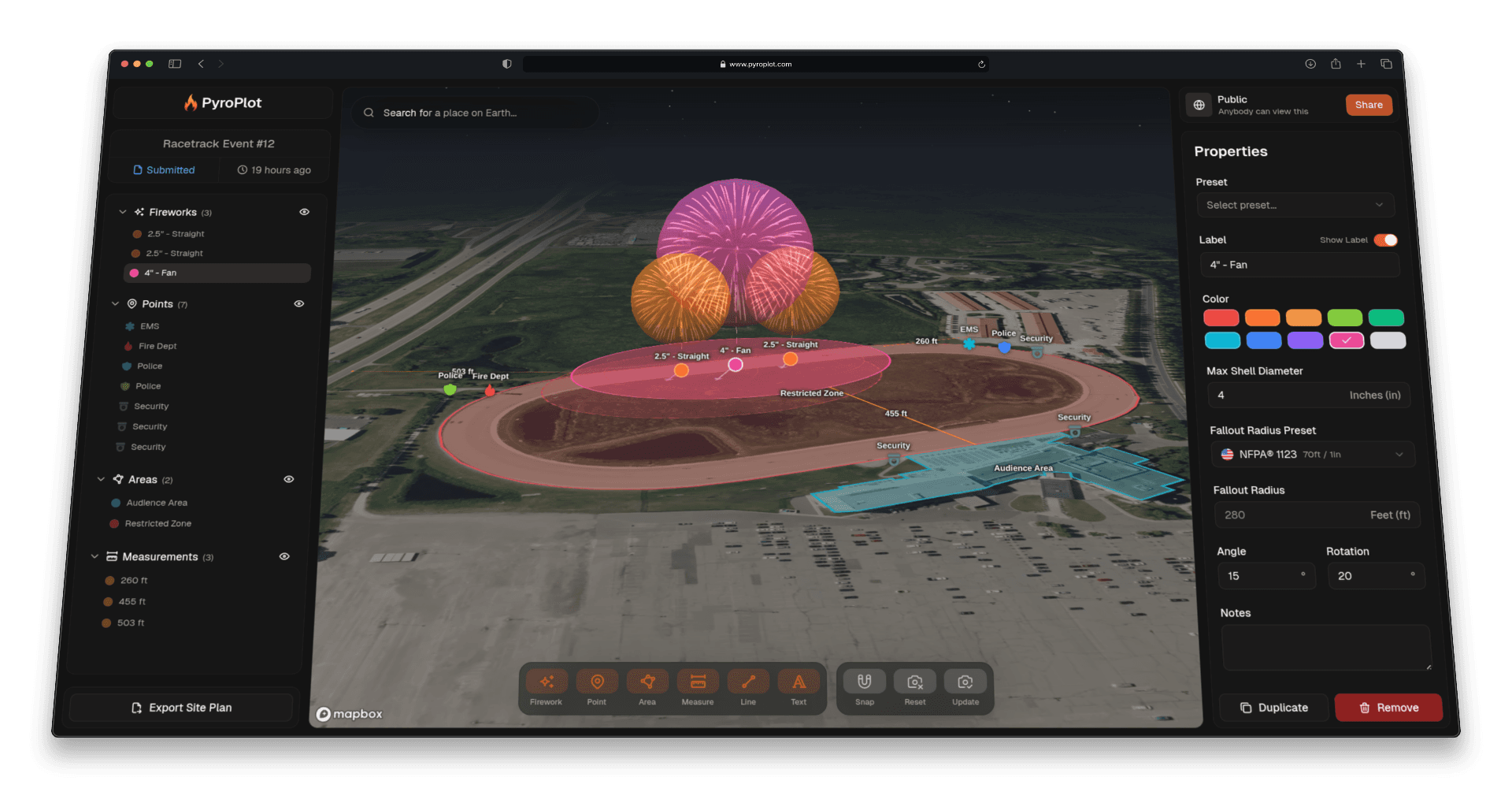
When your show includes a mix of 1.3G display shells, Pro Line cakes, and other devices, keeping your site plan documentation straight matters — especially when an AHJ asks what's going where and under which standard. Pyro Plot's Site Plan Designer lets you lay out your discharge site, document each firing position, and export a clean PDF site plan to submit with your permit application. If you're also tracking Pro Line product in your inventory alongside 1.3G materials, the Inventory Manager gives you a structured transaction ledger to record acquisitions and dispositions by product. Try Pyro Plot free and see how it fits into your pre-show workflow.