
How to Calculate NFPA 1123 Fallout Zones for Fireworks Displays
One of the most critical steps in planning a professional fireworks display is correctly calculating your NFPA 1123 fallout zones. Get it wrong, and your permit application gets denied — or worse, someone gets hurt. Yet many operators still calculate separation distances by hand, referencing multiple sections of the code with no margin for error. This article breaks down exactly how fallout zone calculations work under NFPA 1123 (2026 edition), covering aerial shells, comets, mines, ground pieces, and special effects — so you can walk into your next AHJ submission with confidence.
This article is for informational purposes only and does not constitute legal or safety advice. Always consult applicable regulations and licensed professionals.
What Is a Fallout Zone Under NFPA 1123?
NFPA 1123 defines the fallout area as "the designated area in which hazardous debris is intended to fall after a pyrotechnic device is fired" (Section 3.3.11). This is distinct from the broader display site, which includes the discharge site, fallout area, and all required separation distances from mortars to spectator viewing areas (Section 3.3.42.2).
The fallout area must be an open area free of spectators, unauthorized vehicles, watercraft, and readily combustible materials during the display (Section 5.1.5). Understanding how the fallout zone relates to the overall display site is the foundation of correct site planning.
The Core Formula: 70 ft per Inch of Mortar Diameter
For aerial shells, NFPA 1123 Section 5.1.3.1 establishes a straightforward rule: the minimum required radius of the display site is 70 ft per inch of internal mortar diameter (22 m per 25 mm in metric). This is referenced directly in Table 5.1.3.1.
Quick reference from Table 5.1.3.1:
- 3" shell → 210 ft minimum radius
- 4" shell → 280 ft minimum radius
- 6" shell → 420 ft minimum radius
- 8" shell → 560 ft minimum radius
- 12" shell → 840 ft minimum radius
The radius of the entire display site must be at least as large as required for the largest shell in the show (Section 5.1.3). If you're mixing 3" and 6" shells, your site radius is calculated from the 6" mortar.
Separation Distances by Device Type
Comets and Non-Bursting Mines
For non-splitting or non-bursting comets and mines containing only stars, the required radius drops to 35 ft per inch of mortar diameter — exactly half the aerial shell standard (Section 5.1.3.2).
Roman Candles and Cakes
Roman candles and cakes follow the same rules as chain-fused aerial shells, comets, or mines depending on the effect they produce (Section 5.1.3.4.1). If a cake produces both aerial shell and comet effects, you apply the aerial shell separation distance — the more conservative of the two (Section 5.1.3.4.2).
Ground Display Pieces
Ground pieces are classified by hazard potential. Low-hazard items like lancework, gerbs, and fountains require a 75 ft minimum radius (Section 5.1.3.5.1). Higher-hazard items — large wheels with powerful drivers, large salutes — require 125 ft (Section 5.1.3.5.2).
Chain-Fused Devices
If chain-fused devices are fired from racks or holders not strong enough to withstand a malfunction, the minimum separation distance doubles (Section 5.1.3.3.2). Racks built to handle a catastrophic shell burst maintain standard distances (Section 5.1.3.3.1). This is a common area where operators underestimate their required site size.
Special Effects: Flammable Liquid and Solid Fuel Fireballs
The 2026 edition of NFPA 1123 adds expanded requirements for fireball effects. Flammable liquid fireballs (gasoline, alcohol, etc.) use a capacity-based table found in Section 5.1.3.7.1 — for example, a device up to 5 gallons requires a 75 ft audience separation, while one over 400 gallons requires 600 ft.
New in 2026: solid fuel fireball effects (powdered solids like lycopodium or sawdust) are now governed by Section 5.1.3.8. Separation is the lesser of: a volume-based distance from Table 5.1.3.8.1.1, or 12.5 ft per inch of the device's internal diameter for round devices. If wind is blowing toward the audience, add a 20% buffer (Section 5.1.3.8.4).
Adjustments That Change Your Fallout Zone
Several site conditions require you to expand your calculated separation distances:
- Elevated firing positions: If fireworks are discharged from more than 25 ft above ground, add 25 ft to the spectator separation distance, plus an additional 25 ft for every 100 ft of elevation (Section 5.2.1.2).
- Health care or detention facilities nearby: All distances must be at least doubled from any point of discharge to these facilities (Section 5.1.4.1).
- Bulk hazardous materials storage: Double the standard separation distance between the discharge site and any bulk flammable, explosive, or toxic storage (Section 5.1.4.3).
- Angled mortars: Mortars angled for aesthetic effect require the spectator separation distance to increase proportionally in the direction of the tilt (Section 5.2.1.4.4). Mortars angled away from spectators and offset up to one-third the separation radius follow different rules outlined in Table 5.1.3.1.
Multi-Sized Device Spacing
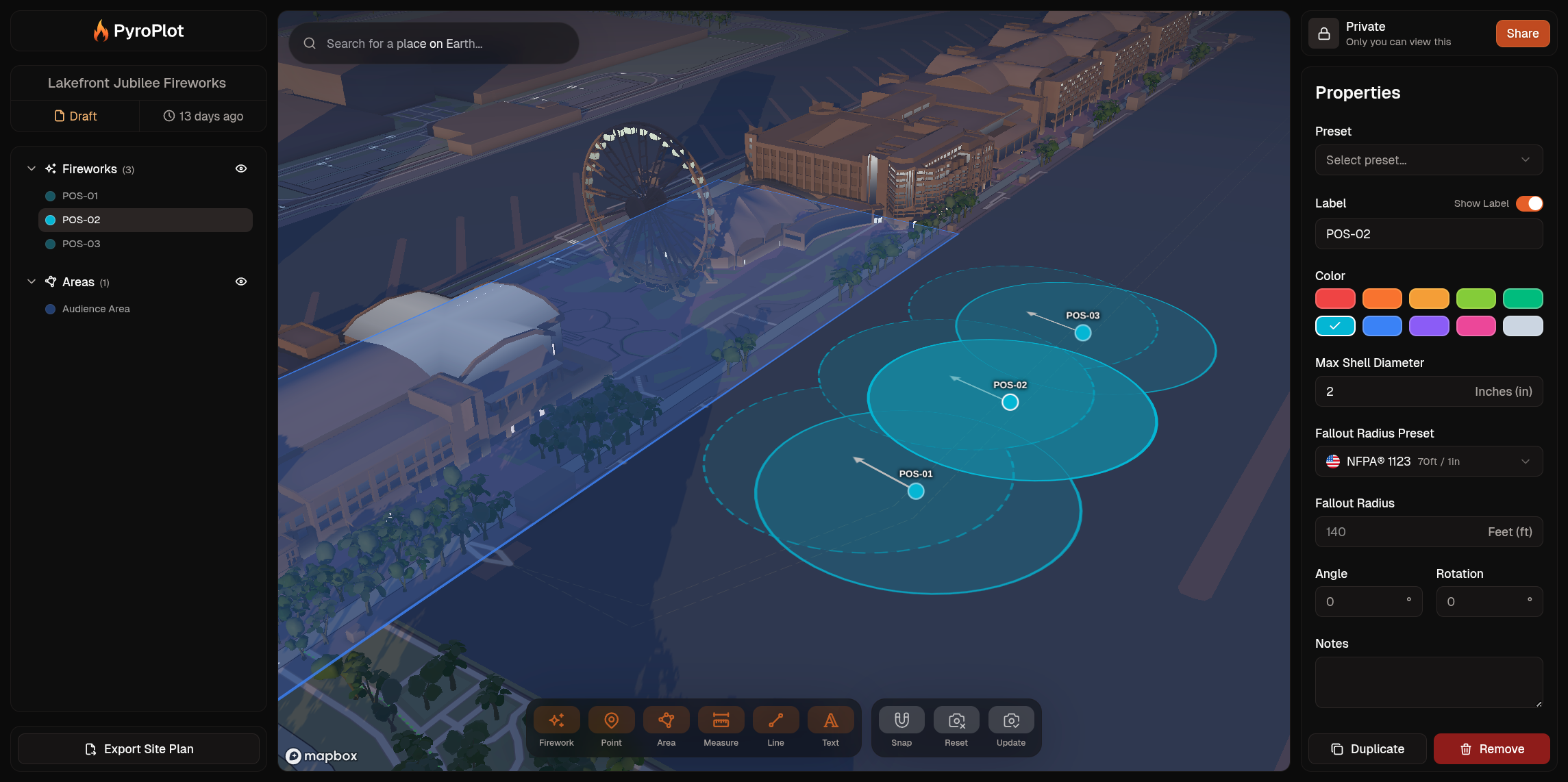
A key clarification added in the 2022 and retained in the 2026 edition: within a single discharge site, smaller devices can be placed closer to spectators than larger ones — as long as each device individually meets its own minimum separation distance (Section 5.1.2.5). You don't have to push every device to the large-shell radius. This flexibility is a real advantage when designing multi-zone shows.
Frequently Asked Questions
What is the NFPA 1123 separation distance formula for aerial shells?
The required minimum radius is 70 ft per inch of internal mortar diameter (Section 5.1.3.1 and Table 5.1.3.1). A 6-inch mortar requires a minimum 420 ft radius from the discharge point to spectators.
Do comets and mines use the same fallout zone as aerial shells?
No. Non-splitting, non-bursting comets and mines containing only stars require half the aerial shell radius — 35 ft per inch of mortar diameter — per Section 5.1.3.2. Bursting comets and mines use the full aerial shell distance.
Does wind affect my required fallout zone under NFPA 1123?
Wind doesn't automatically change the minimum site radius, but mortars may need to be re-angled or repositioned if wind creates a hazard (Section 8.2.8). Flammable liquid effects require a 50% distance increase if wind is blowing toward the audience (Section 5.1.3.7.4).
Can the AHJ adjust the required separation distances?
Yes. Section 5.1.1 grants the AHJ discretion to increase or decrease required distances based on site conditions, added safety precautions, or unusual hazards. Any such adjustment must be documented and approved before the display.
What must be included in the site plan submitted to the AHJ?
Per Section 5.1.2.2, the site plan must include the display site dimensions, discharge site locations, spectator viewing areas, parking areas, fallout areas, and all associated separation distances. Elevated or angled firing positions require additional detail.
Simplify Fallout Zone Calculations with Pyro Plot
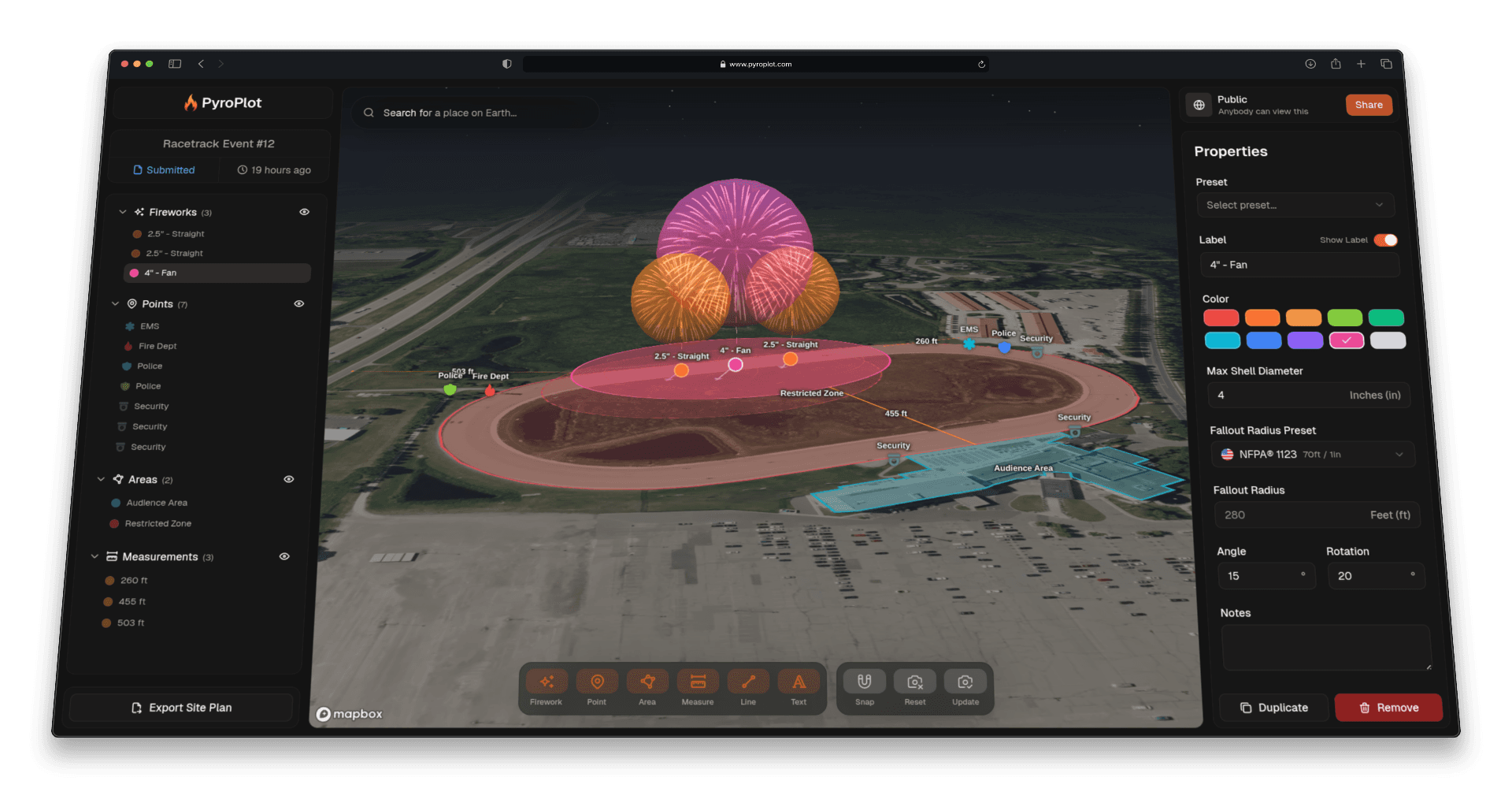
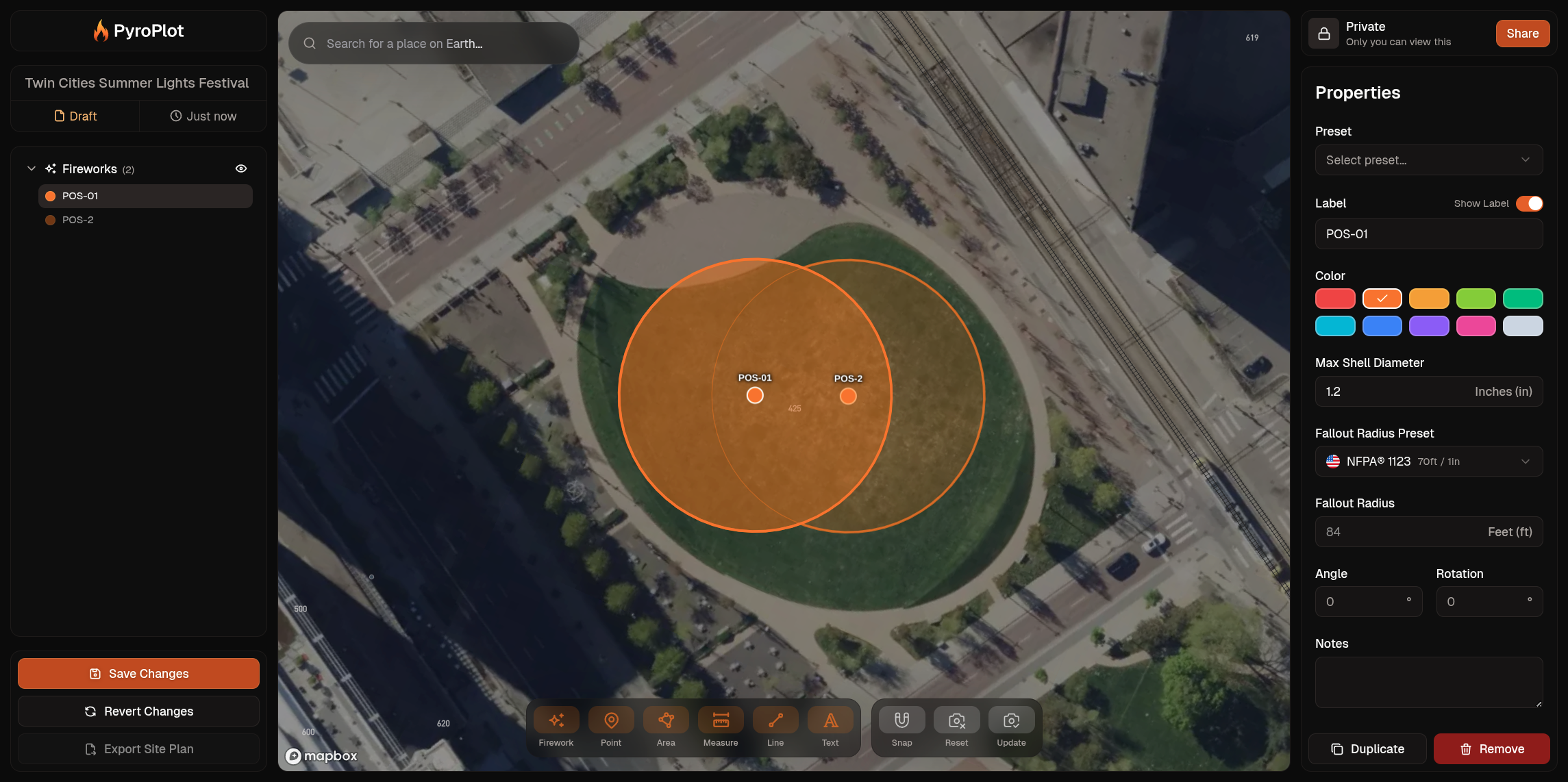
Manually running these calculations for every device in a multi-product show takes time — and leaves room for error. Pyro Plot's Site Plan Designer automates this. When you place a firework annotation on the map and set the shell diameter, the fallout radius is calculated automatically using your chosen preset — including the NFPA 1123 standard of 70 ft/in, the NFPA 1123 non-breaking standard of 35 ft/in, or a custom value. Fallout circles render live on the map, and you can switch between Separate, Combine, and Hybrid display modes to visualize how zones overlap across your entire show layout.
Wind visualization is also built in. Enable it from project settings, set your wind speed and direction, and the designer shifts fallout zones accordingly — giving you a visual check before you're standing on-site with the AHJ looking over your shoulder. When you're ready to submit, the PDF site plan export includes all separation distances, mortar positions, spectator areas, and crew assignments in a clean, professional format.
Pyro Plot is a planning and organizational aid — it doesn't replace your professional judgment or guarantee regulatory approval. But it does cut the time it takes to produce an accurate, well-documented site plan.