
How to Get an ATF Type 54 Federal Explosives User Permit for Display Fireworks
If you want to legally purchase and use 1.3G display fireworks in the United States, you need a federal explosives permit before you can buy a single aerial shell. For most display operators, that permit is the ATF Type 54 Federal Explosives User Permit.
This guide covers what it is, how to get it, what the ATF inspection looks like, and what you're on the hook for once it's in hand.
Disclaimer: This article is for informational purposes only and does not constitute legal or safety advice. Always consult applicable ATF regulations (27 CFR Part 555) and licensed professionals.
What Is the ATF Type 54 User Permit?
The Type 54 is a three-year federal explosives permit issued by the ATF's Federal Explosives Licensing Center (FELC). It authorizes you to purchase and use 1.3G display fireworks from licensed distributors anywhere in the United States, with no cap on how many purchases you make per year.
If you do not intend to engage in the business of importing, manufacturing, or distributing explosive materials, but do intend to acquire and use explosive materials for lawful purposes, you must first apply for and obtain a federal explosives user permit from ATF. The Type 54 is that permit for professional display operators.
The application fee is $100. Renewal every three years costs $50.
Who Can Apply
You must be at least 21 years old. Beyond that, ATF will disqualify applicants who have a felony conviction, a domestic violence conviction or restraining order, a dishonorable discharge, a history of adjudicated mental illness, or unlawful drug use. These checks apply to every responsible person on the application, not just the primary applicant.
If you have anything in your background that could be a disqualifier, that does not necessarily mean you can't get permitted — but expect the process to take longer and consider contacting ATF directly before applying.
How to Apply: Step by Step
Step 1: Order Your Fingerprint Card
Start here, because the card ships by mail and takes time to arrive. You need the FBI FD-258EX – Explosives Applications version specifically. Check the "Fingerprint Cards" box and select the explosives version from the dropdown when ordering.
Once the card arrives, take it to your local police department to have your prints taken. Call ahead on a non-emergency line — some departments do it for free, some charge a small fee, and some have limited hours for this service.
Order your FBI FD-258EX fingerprint card from the ATF Distribution Center
Step 2: Get a Passport Photo
You need a 2x2 inch photograph for your application. Any pharmacy, office supply store, or AAA location that offers passport photos will work. You can also take your own if it meets the State Department's standards.
Review passport photo requirements from the U.S. State Department
Step 3: Sort Out Your Storage Plan
ATF requires that you have a compliant plan for storing explosive materials. You have two options.
The first is your own approved magazine, which must meet ATF storage regulations under 27 CFR Part 555.
The second, and far more common option for operators just starting out, is a contingency storage arrangement with a licensed distributor. This means your distributor holds your product and you pick it up the day of your show, returning anything unused afterward. Your distributor provides a signed contingency storage letter that goes into your application package. If you do not yet have your own magazine, this is the path to take — it keeps the application clean and avoids delays that can come from trying to get a new magazine approved at the same time.
Review ATF explosives storage requirements
Step 4: Complete ATF Form 5400.13/5400.16
This is the main application. A few fields to pay close attention to:
On the permit type selection, choose "User of Explosives – Fireworks." Do not select the limited permit option.
For hours of operation, you are required to list at least one window of time when ATF can reach you. This is simply your availability for contact and inspection scheduling. It does not need to be a commercial business schedule.
For the interstate commerce questions, if you plan to buy from out-of-state distributors or shoot shows in multiple states, answer yes. Most operators should.
Every responsible person on the application must also complete ATF Form 5400.13A/5400.16, the Responsible Person Questionnaire.
If you have employees who will handle display fireworks as part of their work, they each need to submit ATF Form 5400.28, the Employee Possessor Questionnaire, and pass a background check before they touch product.
Download ATF Form 5400.13/5400.16 (Federal Explosives License/Permit Application) from the ATF
Download ATF Form 5400.28 (Employee Possessor Questionnaire) from the ATF
Step 5: Mail Your Complete Package
Send everything to ATF's Federal Explosives Licensing Center lockbox in Portland. Missing any item will delay your application, so double-check before you seal the envelope.
Your package should include:
- Completed ATF Form 5400.13/5400.16
- Responsible Person Questionnaire for each responsible person
- FD-258 fingerprint card for each responsible person
- 2x2 passport photo for each responsible person
- $100 application fee (check, credit card info on the form, or money order — no cash)
- Contingency storage letter from your distributor, or your magazine details
- Copies of any state or local permits you already hold
Mail to:
Bureau of Alcohol, Tobacco, Firearms, and Explosives Federal Explosives Licensing Center PO Box 6200-18 Portland, OR 97228-6200
The Federal Explosives Licensing Center will approve or deny a properly completed application within 90 days from the date of receipt. From start to finish, including document gathering and the field inspection, plan for three to five months. If you're targeting a summer season, get your application in no later than January.
The IOI Inspection
After FELC processes your paperwork and background checks clear, your application goes to your local ATF field office. An Industry Operations Investigator (IOI) will contact you to schedule a face-to-face meeting.
The IOI is not there to catch you off guard. They want to confirm that you understand the rules and have a realistic plan to follow them. The conversation will cover your storage arrangement, how you handle product before and after a show, and your recordkeeping plan. If you've thought through your workflow, the meeting is straightforward.
Be ready to explain:
- How and where you'll store product (your magazine or contingency arrangement)
- How you handle leftover fireworks after a display
- How you'll maintain your acquisition and disposition records
- Whether you have any employees who will be handling product, and whether they've been submitted for background checks
Answer every question honestly. The application and the interview need to match. After the inspection, the IOI submits their report and FELC issues your permit, assuming everything checks out.
After You're Approved
When your permit arrives, do not sign the original. Make a copy, sign the copy, and keep the original somewhere safe. A copy of the license with an original signature is equivalent to the original for proof of license purposes. Send a signed copy to any distributors you plan to buy from before your first order.
From that point forward, you have three ongoing recordkeeping obligations.
Acquisition Record. Every time you purchase regulated fireworks, you need a record of the date, product type and quantity, and the seller's license information. Most licensed distributors generate a disposition record that satisfies this requirement automatically. Keep every one.
Daily Summary of Magazine Transactions (DSMT). If you operate your own magazine, you maintain a running log of everything going in and out, with a current on-hand count. If you're using contingency storage and picking up product the day of each show, this requirement doesn't apply to you.
Disposition Record. A record of every time product leaves your possession — whether used in a show, returned to a distributor, or destroyed.
ATF will inspect you at least once every three years. When they do, they'll pull records from your distributor and compare them against yours. Keep everything current and you'll have nothing to worry about.
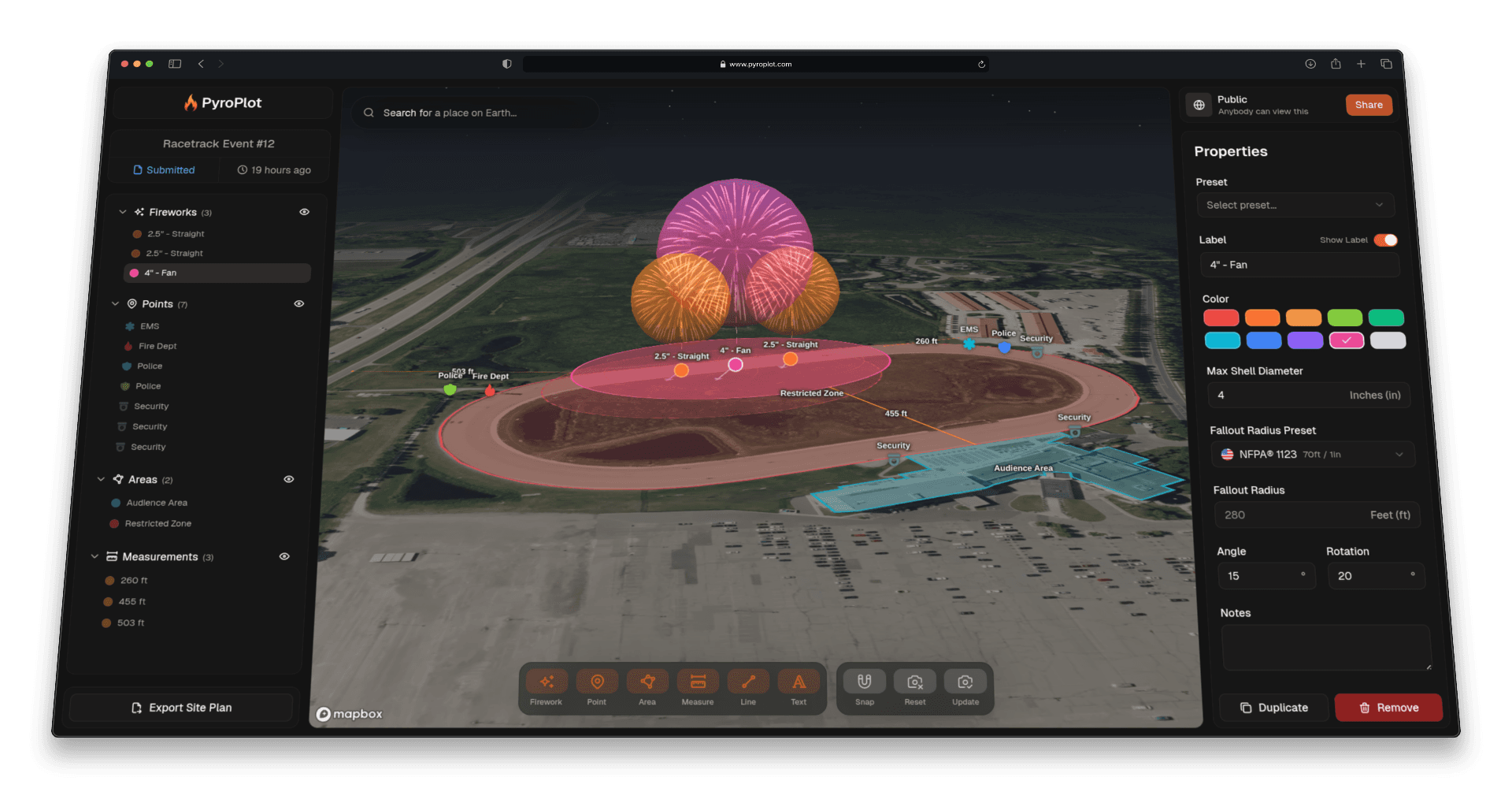
Staying organized across multiple shows, distributors, and seasons is where operators tend to slip. Pyro Plot keeps your acquisition and disposition records in a compliant, immutable ledger, tracks magazine inventory, and lets you export everything to CSV when ATF comes knocking. It also handles your NFPA 1123 site plans, so your compliance records and your display documentation live in the same place.
Frequently Asked Questions
What is the ATF Type 54 User Permit? It's a three-year federal permit that authorizes licensed pyrotechnic operators to purchase and use 1.3G display fireworks from licensed distributors anywhere in the United States, with no limit on the number of transactions per year.
How much does the ATF Type 54 cost? The initial application is $100. Renewal every three years is $50. Payment can be made by check, credit card, or money order.
How long does it take to get a Type 54 permit? ATF aims to process complete applications within 90 days. Including the field inspection and document gathering, most applicants should budget three to five months from start to finish.
Do I need a state license in addition to the ATF permit? In most states, yes. The Type 54 covers your federal requirement. State licensing for display operators is separate and governed by your state fire marshal. Requirements vary widely by state.
Can my employees handle display fireworks under my permit? Employees who have actual possession of explosive materials must submit ATF Form 5400.28 and pass a background check. They operate under your permit, but their eligibility has to be verified separately before they handle product.
What records do I have to keep as a Type 54 holder? An acquisition record for every purchase, a disposition record for every use or transfer, and a daily magazine inventory log if you operate your own storage. ATF inspects these at least once every three years.